Translation: 


Atypical Moles & Your Skin
The Facts. The Risks. How They Affect You.
People with 10 or more atypical moles have
12x THE RISK OF
MELANOMA

Atypical moles, also known as dysplastic nevi, are unusual-looking moles that have irregular features under the microscope. Though benign, they are worth more of your attention because individuals with atypical moles are at increased risk for melanoma, a dangerous skin cancer.
An atypical mole can occur anywhere on the body. The appearance of these moles can vary greatly. The best advice is to know your skin. Keep track of any and all moles you may have. This gives you the best chance to spot anything new, changing or unusual and bring it to the attention of your dermatologist.
What you need to know
- An atypical mole is not a skin cancer but having these moles is a risk factor for developing melanoma.
- Although rare, melanoma can arise in association with atypical moles. That is why it is important to be aware of these moles, get them checked by your dermatologist, and watch out for changing moles.
- If you have atypical moles plus a family history of melanoma, you have an increased risk of developing melanoma.
- If you have any common melanoma risk factors plus atypical moles, you must be particularly watchful:
- Fair skin, light eyes or hair
- Freckles
- Many moles
- A personal or family history of melanoma or nonmelanoma skin cancer
- Photosensitivity
- Inability to tan
- Repeated and intermittent sunburns
It’s important to note that even without a family history of melanoma, if you have atypical moles, you have an elevated risk of developing melanoma.
How to spot an atypical mole
At first glance, it can be tricky to see how an atypical mole differs from a normal mole. Below are some warning signs to watch for.
The ABCDE Warning Signs
The first five letters of the alphabet can be used as a guide to the warning signs for atypical moles and melanoma.
A is for Asymmetry. Most melanomas are asymmetrical. If you draw a line through the middle of the lesion, the two halves don’t match, so it looks different from a round to oval and symmetrical common mole.
B is for Border. Borders tend to be uneven and may have scalloped or notched edges, while common moles tend to have more smoother, more even borders.
C is for Color. Multiple colors are a warning sign. While benign moles are usually a single shade of brown, a melanoma may have different shades of brown, tan or black. As it grows, the colors red, white or blue may also appear.
D is for Diameter and Dark. While it’s ideal to detect a melanoma when it’s small, it is a warning sign if a lesion is the size of a pencil eraser (about 6 mm, or ¼ inch in diameter) or larger. Some experts say it is also important to look for any lesion, no matter what size, that is darker than others. Rare, amelanotic melanomas are colorless.
E is for Evolving. Any change in size, shape, color or elevation of a spot on your skin, or any new symptom in it, such as bleeding, itching or crusting, may be a warning sign to see your doctor.
When in doubt, check it out: Your dermatologist will determine whether your pigmented lesion is an atypical mole or a melanoma, and provide you with detailed information about next steps.
Images: What to watch for
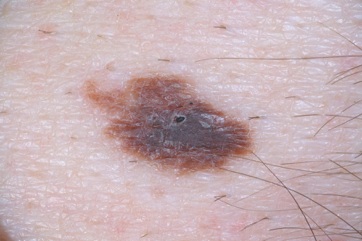
Atypical mole with asymmetry, border irregularity and multiple shades of brown.
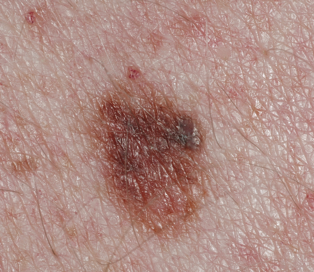
Atypical mole with asymmetry, border irregularity, color variations and diameter greater than ¼ inch
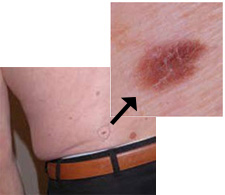
Atypical mole on lower back. Close-up of mole (on right) shows asymmetry, color variegation and border irregularity.
Please note: Since not all atypical moles have the same appearance, these photos serve as a general reference for what they can look like. If you see something new, changing or unusual on your skin, schedule an appointment with your dermatologist.
What causes atypical moles?
Scientists and researchers are still working on understanding what causes atypical moles. The reason they develop is believed to be a combination of genetic and environmental factors.
Atypical mole syndrome
People with atypical mole syndrome (also known as dysplastic nevus syndrome) are at especially high risk of developing melanoma. The syndrome is associated with the following three characteristics:
- 100 or more moles
- One or more moles 1/3 inch (8 mm) or larger in diameter
- One or more atypical moles
If you have hereditary risk factors for melanoma as well as many atypical moles, you may be classified as having Familial Atypical Multiple Mole Melanoma Syndrome (FAMMM), putting you at even greater risk for developing melanoma.
What is the treatment for atypical moles?
If you have one or more atypical moles, see a dermatologist. It’s important to get professional guidance on how to keep track of changes. Your dermatologist will know whether or not any moles need a biopsy to ensure they are not melanomas. The more abnormal features moles have, the riskier they are. Frequent monitoring of these moles is especially crucial, so that if a melanoma arises, it can be detected and treated as early as possible.
If your doctor identifies a mole as suspicious, or if new moles appear after age 40, you may need a biopsy.
What you can do
Know your skin: If you have atypical moles, FAMMM or other melanoma risk factors, perform monthly self-checks and visit your dermatologist regularly (at least once a year) for thorough head-to-toe skin exams. Talk to your doctor at length about self-monitoring steps you need to take. Advise family members to do the same.
Be on the lookout: See your dermatologist if you notice any of the ABCDE melanoma warning signs or any of the following changes on your skin:
- Itching, bleeding, crusting, oozing or swelling of a skin lesion
- Changes in color, size, shape, texture or elevation of a skin lesion
- Pain
Protect against UV rays: You can reduce the skin cancer risk posed by UV-radiation by taking simple protective measures. Safeguard your skin against the sun every day, even when it’s cloudy. Avoid indoor tanning entirely. Get the details on how to make healthy skin a way of life: Your Daily Sun Protection Guide.
Reviewed by:
Adele Haimovic, MD
Jesse M. Lewin, MD